Wednesday, 6 February 2013

Development - silent films, sketches, prop gathering, teeth photography


Been watching silent films for research to get a better feel and look at peoples expressions and body language without spoken word. One film was that of  'The Cabinet of Dr Caligari' (1920) which is a German silent horror film with the heavy style of German expressionism. The sets are all hand made and have surreal perspectives and jagged edges making a bizarre environment for the characters. The actors also use very excited and exaggerated gestures to add to the strange mood. It was interesting to watch a very dark but beautifully crafted film that had the same tones that I felt related in ways to my project.


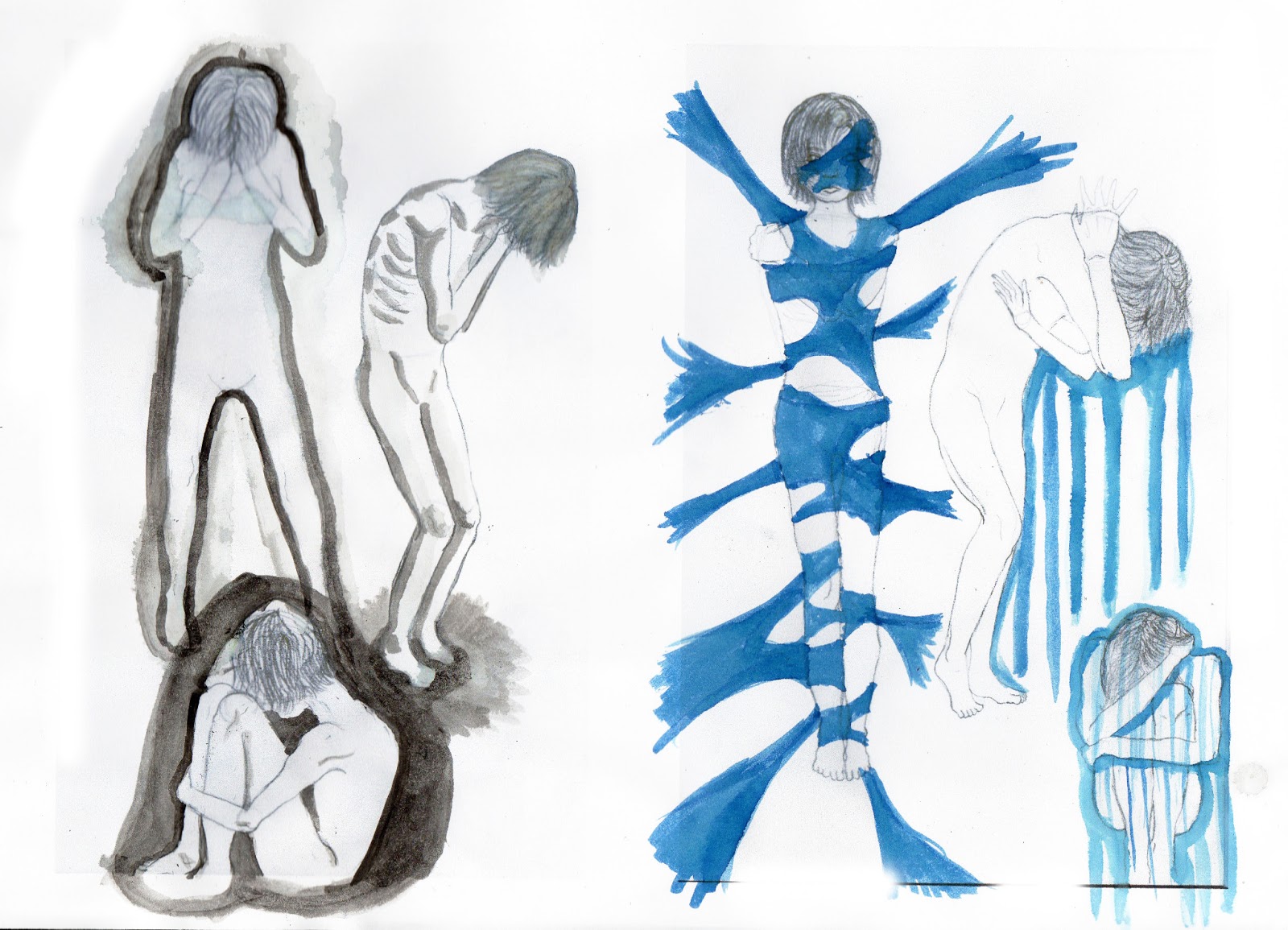
These are the sketches I did based on the photography of myself in various different poses. Their to express negative body language and to get a feel for what I want to do when I get into the photography studio. I have did some media tests with ink since I'll be using this and other medias for further studies and for the Photo shoots. Also to practice being more expressive artistically and to ease into drawing for when I'm story boarding.


 
Also have made a small advertisement to ask for models around the art university. Some have been put up around the building now and I have had some interest already which is exciting. Some classmates have volunteered also to help out and I'll be doing a photo shoot with one shortly which I hope goes well. Not actually did a photography series with models before except myself so I feel positive about learning in this experience.


These are some sketches that I have done for the storyboard of each shoot. Their may be more planned as I have been still gathering materials and planning out each shoot. I find drawing storyboards for the model's to look at to show what is inside my head is very useful. As a visual representation of what I want to achieve and how I want them to be posed and also for the props. I'm open to suggestions for the models as well as trying out different things with the angle,lighting,props, etc. Since this is all for experience and learning.


These are planned out to relate to different types of anxiety illness's and disorders and I will be using different medias and plans for each one. As well as planning how the props will represent each meaning and what they represent. As an example the image right above this one is about how depression controls us and how it effects our lives. Part of the symptoms is high phases of fatigue, Insomnia, unhappiness, agoraphobia, and difficulties in commitments or relationships. As experiencing this myself and researching it seems a big part of it is being so unhappy you cant get out of bed and face the day. And the model being in a bed with chains wrapped around that is supposed to represent this. But this may be elaborated on further with props or meanings and the storyboards will be worked on further.


This is also my work space just now in the studio I find its its better organized and to get my thoughts and ideas better together. The sticky notes are ideas and findings on what I have found inside the symbolism books and are ones that struck me the most for imagery and attainable props.


These are the props that I have managed to collect in the past couple of weeks which includes different colors of fabric, black and white paint, a spice rack, a mirror, butterfly stickers, tea set, a mask and false teeth.

The teeth were kindly given to me by the dental hospital and they were really helpful and friendly and even showed me how to make my own. They gave me plenty of sets and molds to use as I please.
The reason I have asked for teeth in the first place is because teeth have a high meaning in the unconscious and especially in dreams. If you dream about loosing teeth this is because your unconsciously afraid of what others perceive you as and aware of your self image. It can also represent growing older and loosing power since bearing teeth is a sign of aggression.


I have started to paint one of the sets to see how well the clay can take paint and they may be used for a photo shoot. I plan to try to make them look more realistic in color and use varnish to make the teeth have the slight gleam they have. These may be used for installation purposes and if the project goes well.

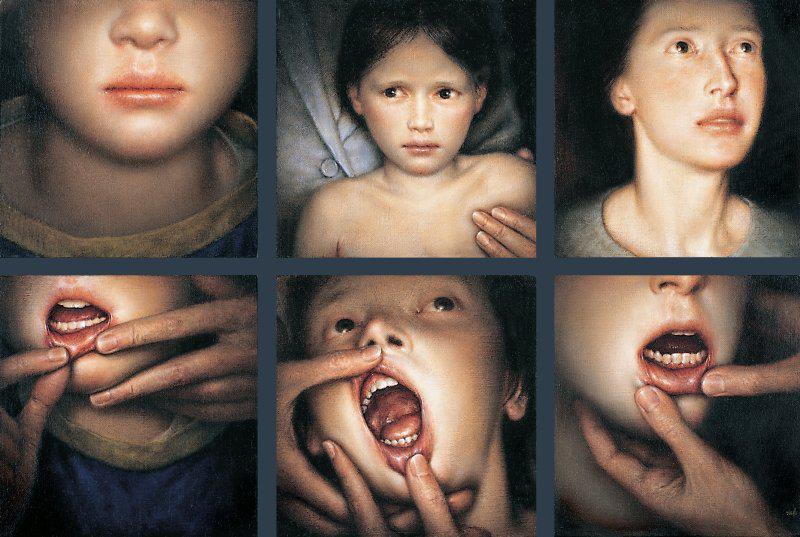
As for the first experiments with photography I used a set of the false teeth since they were the first prop I managed to get a hold of. I would like to use them in a studio setting with models but these were just tests for something simple with simple lighting.


How the tone of lighting can set a completely different feel and mood to an image and the context of an image even if its simple. For instance how the different way the hands are holding can convey a different meaning and gesture. This will be explored further as I get more lighting and photography tutorials in University. As well as more experimentation within a studio environment and with different props and lighting. I will be looking into lighting a lot further and will be experimenting with a model in the studio shortly.

Saturday, 2 February 2013

Research - Helen Chadwick


Helen Chadwick (18 May 1953 – 15 March 1996) was a British conceptual artist.

Chadwick studied at Croydon College of Art, The Faculty of Arts and Architecture Brighton Polytechnic and then at the Chelsea School of Art.

She lived in Beck Road, Hackney,where one of her first London friends was another resident of the street, Maureen Paley. Paley and other friends took part in Chadwick's first London show, a feminist performance titled In the Kitchen, by strapping themselves in a canvas model of a cooker. Chadwick guided Paley in the conversion of her home into a space for art exhibitions. Paley said, "Helen was always talking about craftsmanship—a constant fount of information".


She has often been identified as a feminist, with several of her works addressing the role and image of woman in society, especially in her postgraduate days and alongside her colleague and friend Elaine Shemilt.


 Work

Her work often reflected her sometimes uneasy relationship with her own body and her partners body, using organic materials, such as meat, flowers and chocolate. She is perhaps most famous for Piss Flowers (1991–92), bronze sculptures cast from cavities made when urinating in the snow by both Helen Chadwick and her husband David Notarius.
Earlier works include Viral Landscapes, a series of photographs from the late 1980s where blotches (actually magnified images of cells from her body) are superimposed over landscapes, and Meat Abstracts (1989) large photographs of meat juxtaposed with leather and fabric.
Right from early art school, I wanted to use the body to create a sense of inner relationships with the audience.


To look at her work in the context of art history it is interesting to see the differences between her approach to her own body and the way the female figure was used in the past.
"In Ego Geometria Sum: The laborers X" of 1984, she is attempting to use her body in a decorative or seductive way, attempting to lift a large box covered with a picture of her own body, she is literally struggling under the weight of her own image and self importance, which was something perhaps doubly applicable to her as both a woman and an artist in the public eye.
While in her earlier work she questioned the role of the female body in art as a decorative object, just as decorative and aesthetic ideas about art themselves had been questioned in the 20th century, in the late 80s she changed saying,

  "I made a conscience decision in 1988 not to represent my body. It immediately declares female gender and I wanted to be more deft."


Chadwick thereby abandoned this practice to become more visceral and moved inside the body to human flesh, and what is common to all of us but we avoid thinking about. However, she did not abandon the themes of sexual identity and gender identity. Her Cibachrome transparencies of 1990 entitled "Eroticism" depict two brains side by side.


In 1995, Chadwick took up an artist residency in the assisted conception unit at Kings College Hospital, London, photographing IVF embryos rejected for implantation.She used the photos in Unnatural Selection, a series on which she was working when she died.
Ten of her works, including Cyclops Cameo and Opal, were destroyed in the May 2004 fire at the Momart warehouse in London.
Chadwick was nominated for the Turner Prize in 1987.
She died in 1996 from a viral infection that weakens heart muscle preventing it from pumping. The virus was contracted while working in a hospital


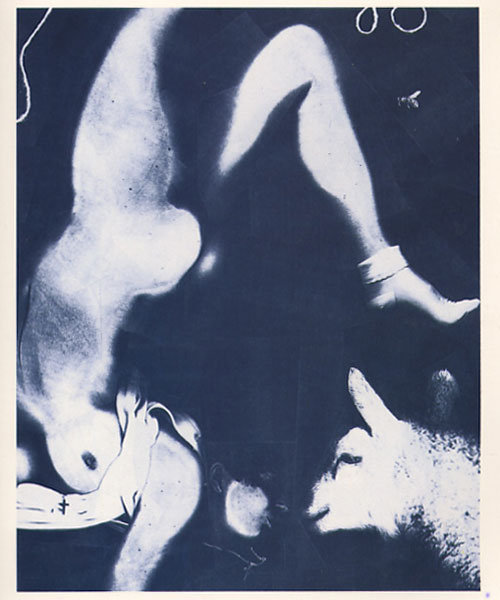
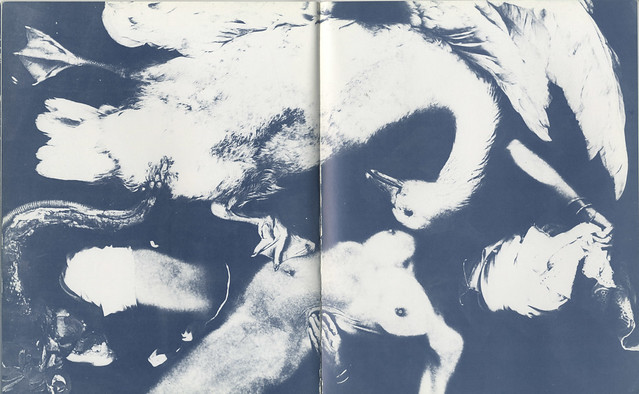
I have became fond of Chadwick's work after being introduced to her by my tutor. The type of messages she portrays through media's especially in her installation pieces. She tends to portray the human body and its relationships with others in gender roles and with props. She translates very direct and personal messages in clever ways of creating the images and installations. Using different symbols to show gender roles and romance as well as her personal life. I found her 'Mutability' series to be the most interesting and useful relating to this project. Which was a series she created by using her self and props such as animals inside a giant photocopier machine. Their very dramatic and beautiful and I would like to be able to capture that in my photography digital or otherwise.

Research - Joel-Peter Witkin Photographer


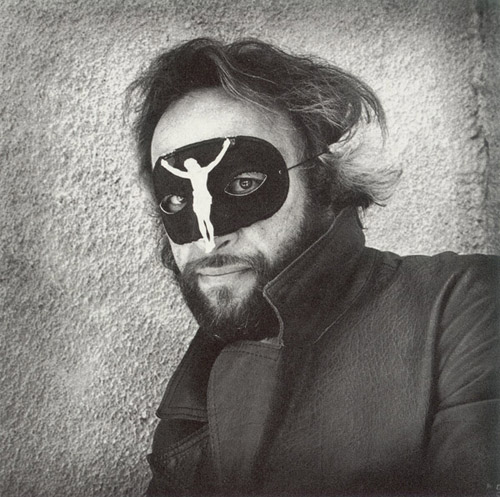
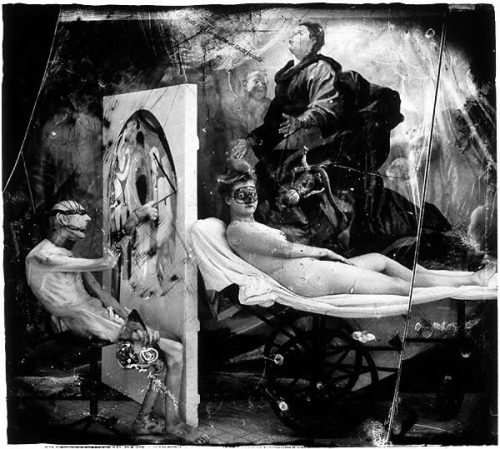
Joel-Peter Witkin (born September 13, 1939, in Brooklyn, New York City) is an American photographer who lives in Albuquerque, New Mexico. His work often deals with such themes as death, corpses (and sometimes dismembered portions thereof), and various outsiders such as dwarves, transsexuals, hermaphrodites, and physically deformed people. Witkin's complex tableaux often recall religious episodes or classical paintings.

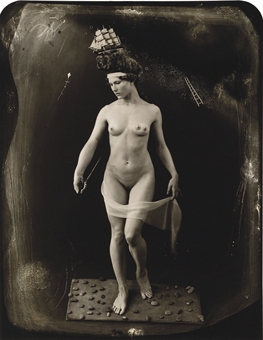
 Beauty has three nipples

Influences and themes

Witkin claims that his vision and sensibility spring from an episode he witnessed as a young child, an automobile accident in front of his house in which a little girl was decapitated.

“    It happened on a Sunday when my mother was escorting my twin brother and me down the steps of the tenement where we lived. We were going to church. While walking down the hallway to the entrance of the building, we heard an incredible crash mixed with screaming and cries for help. The accident involved three cars, all with families in them. Somehow, in the confusion, I was no longer holding my mother's hand. At the place where I stood at the curb, I could see something rolling from one of the overturned cars. It stopped at the curb where I stood. It was the head of a little girl. I bent down to touch the face, to speak to it -- but before I could touch it someone carried me away".    ”

He says his family's difficulties also influenced his work. His favorite artist is Giotto. His photographic techniques draw on early Daguerreotypes and on the work of E. J. Bellocq.

 Poussin in Hell

 Ars Moriendi

Techniques

Those of Witkin's works which use corpses have had to be created in Mexico in order to get around restrictive US laws. Because of the transgressive nature of the contents of his images, his works have been labelled exploitative and have sometimes shocked public opinion.
His techniques include scratching the negative, bleaching or toning the print, and using a hands-in-the-chemicals printing technique. This experimentation began after seeing a 19th-century ambrotype of a woman and her ex-lover who had been scratched from the frame.

Witkin begins each image by sketching his ideas on paper, perfecting every detail by arranging the scene before he gets into the studio to stage his elaborate tableaus. Once photographed, Witkin spends hours in the darkroom, scratching and piercing his negatives, transforming them into images that look made rather than taken. Through printing, Witkin reinterprets his original idea in a final act of adoration. 

Madame X
Leda

Joel-Peter Witkin is a photographer whose images of the human condition are undeniably powerful. For more than twenty years he has pursued his interest in spirituality and how it impacts the physical world in which we exist.

Finding beauty within the grotesque, Witkin pursues this complex issue through people most often cast aside by society -- human spectacles including hermaphrodites, dwarfs, amputees, carcases, people with odd physical capabilities, fetishists and "any living myth... anyone bearing the wounds of Christ." His fascination with other people's physicality has inspired works that confront our sense of normalcy and decency, while constantly examining the teachings handed down through Christianity.


His constant reference to paintings from art history, including the works of Bosch, Goya, Velasquez, Miro, Botticelli and Picasso are testaments to his need to create a new history for himself. By using imagery and symbols from the past, Witkin celebrates our history while constantly redefining its present day context.

Visiting medical schools, morgues and insane asylums around the world, Witkin seeks out his collaborators, who, in the end, represent the numerous personas of the artist himself. The resulting photographs are haunting and beautiful, grotesque yet bold in their defiance a hideous beauty that is as compelling as it is taboo.

Joel-Peter Witkin lets us look into his created world, which is both frightening and fascinating, as he seeks to dismantle our preconceived notions about sexuality and physical beauty. Through his imagery, we gain a greater understanding about human difference and tolerance.


Documentary about his work may contain graphic or disturbing content.

Been aware of Witkin's work for a few years now and his work has made me view art and photography on whole new levels. Such as questions about the types of materials and processes we use to create art. Such as is the human form really an art material even after it has passed? Is it wrong to photograph people with deformities or abnormalities? Is it breaking respect or is making work about them a higher sign of it?

It was an old trade to photograph the dead called 'Memento Mori' and also not uncommon to photograph circus folk which gave them the public eye and a living. I felt he is an important photographer since he is pushing boundaries in the art world with technique and his subject matter. His use of symbolism in his work is all carefully planned out to the very last detail. Including the figures he asks to model for him and how he storyboards each piece before producing it. Also his extensive use of props which he collects or creates hims self to get the desired effect. I will be story boarding and collecting or creating props for my pieces for this project in a very similar way. Felt he was a strong example to research as a photographer and his themes or taboo subjects.

Wednesday, 30 January 2013

Research - Dino Valls Modern Symbolist painter


For research I wanted to look into more modern symbolist artists as well as older ones to get examples of the old and the new of this movement.
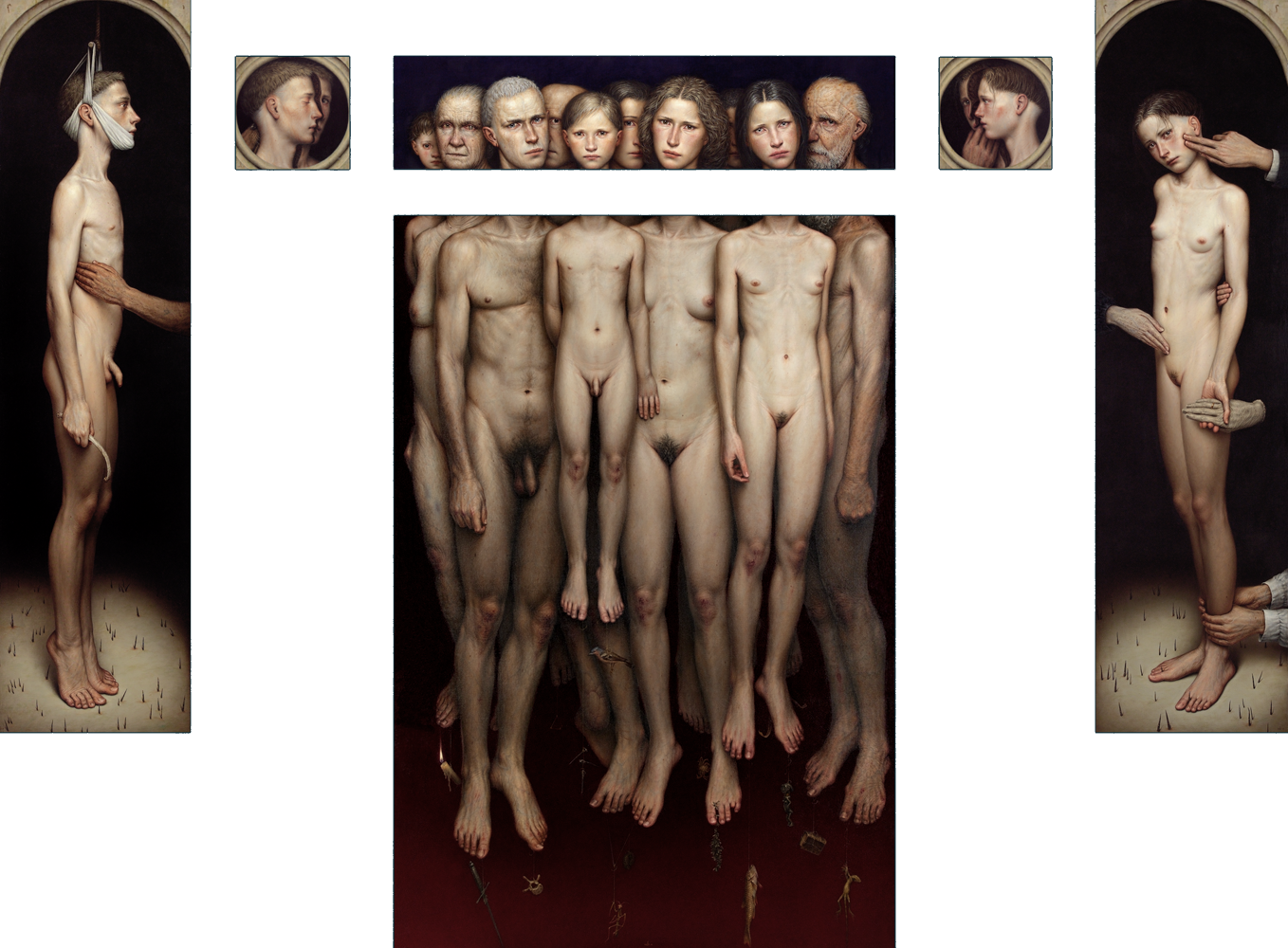
I have been aware of Dino Valls work for a few years now and he's an artist that is difficult to forget in skill and subject matter. I thought his paintings were the work of digital age but his work has introduced me to the technique of egg tempra which I would like to try in the future. He's been picked for research because of the effect his work has on me and how he portrays the human body and psyche in a beautifully disturbing manner. How he is able to explore the symbolism and world he creates for his figures and show us places we thought were only in our deepest thoughts


Íncubo 1992

Dino Valls (Spanish, figurative, symbolism, 1959-) His painting, elaborating and expanding the methods of past masters, centers on the human psyche by using figurative techniques only as a formal support in which to project a conceptual content laden with profound psychic weight, where the most obscure pulsations develop in a symbolic process of intellectualism.
 

Having previously obtained a degree in medicine, he is now one of the Spanish representatives of the vanguard of figurative art. His painting, elaborating and expanding the methods of past masters, centers on the human psyche by using figurative techniques only as a formal support in which to project a conceptual content laden with profound psychic weight, where the most obscure pulsations develop in a symbolic process of intellectualism. He has participated in important international exhibitions of contemporary art, and has held numerous showings in Europe and the United States.
He is a self-taught artist with an early involvement in drawing. He began painting oil in 1975.  During his medical studies at the University of Zaragoza, he continued his painting and submitted his work to various art competitions in Spain and France, where he receive several awards.

His first one-man exhibition was received in Zaragoza in 1981. The following year he was awarded the San Jorge First Place Award in Painting, after receiving his degree in medicine and surgery in 1982, he decided to devote himself exclusively to painting; the kind of painting which would be influenced by the humanistic perspective that brought  about the study of man. This kind of attitude is reminiscent of the creative climate of the Renaissance.
In 1987 he was select by the Ministry of foreign affairs to participate in the exhibition of Contemporary Spanish Art in Germany and had a one-man exhibition in the Heller Gallery in Madrid, a city where he has lived since 1988.
His passion for ancient painting moved him to study seriously the techniques of the great masters in the major European museums. In the mean time, he continued to participate in one-man and group exhibitions. 

 Barathrum

In 1991 Valls studied the art of egg tempera and the technique of the Italian and Flemish masters of the 16th and 17th centuries. Egg tempera remains his favorite technique for painting.  In 1993 Valls began participating in various U.S. art fairs in Miami, New York,  South America and Australia.
Art is the only medium which allows man to unite his logical thought and his magical thought, redeeming him from the profound dichotomy which exists between both. Curiosity incites us to step out into the field of logic, raising our gaze beyond what may be recognized. This may be the point of inflection which leads us unreality in Dino Valls' painting.

One of the privileges by those dedicated to art is that related to a special form of possession. Although a person's desire to grasp another may never be completely fulfilled, being able to create an image the possession of which begins and ends strictly in the actual creation, is an eminently artistic prerogative, that in addition to being much more satisfactory, accompanies another aspect which is not of less importance: he concept of endopathy, according to which, in order to paint a figure, one has to become it. Just as all paintings are self-portraits, only mirrors hang on the walls, which means an extension of the relation between participation and effect upon each other by the work of art, the author and the spectator.

 
Mysterium Coniuncationis

On the other hand, the relation between the person who looks and what is being contemplated causes archetypes to appear and ends up by establishing an active communication between the work and the receiver, as it is based on the power of projection which the unconscious causes to arise in the person looking.
The gaze discovers the painting and this reveals what we only know intuitively: the irrational. It is during our attempt to rationalize it that the conflicts arises, originating in our collective cultural unconsciousness, which scientific research continues to try to unmask.

Just as dreams disguise themselves as reality to make themselves recognizable for the consciousness, Dino Valls` painting conceives his artistic ideas based on the artist's interior unreality. Neither realism as naturalism, nor a fleeting personal view of the real world concern him. It is not the exterior and its objective reality that attract him, but rather the contrary. This is a search inside oneself, plunging into the warehouse of what underlies everyday experience. In his work, the painter reveals these profound conflicts, and the spectator recognized them as part of his internal struggle, as they belong to the same human essence.

Alicia Guixa, Catalogue, "Dino Valls", Madrid (December 1993)

 Introitus

The sample below taken from his website could explain his work better than I could.

Fernando Castro Florez
(Professor of Aesthetics and Art Theory at the Universidad Autonoma de Madrid, art critic and curator

(...) We could understand the whole aesthetic of Valls as a kind of speculation about the condition of the contemporary subject. His paintings are mirrors in which anxiety is settled and the painful process of split personality. The darker monster is actually inside us. The most beautiful bodies and even "angelic" are wounded and since especio of representation, challenge us. Images in apostrophe in the faces impose abysmal dimension or better, medusea of ​​gaze. We can not escape the gaze shocked or disturbed painting figures Dino Valls, those eyes are on the verge of something we do not understand, as if waiting for something that we can not do. His symbols allegorize the unconscious drives appoint tangentially allude to transformation processes, retake a thought that goes beyond the crosslinking exerted by the rational. (...)
 
(...) Experts often revel in his technique and especially with what he describes as "immaculate brushwork", to which the artist replies that it is just the opposite: "My painting serves to bring darkness, anxiety, torment. What I do as an artist is to delve into the darkest and most unknown of man. My painting would come to be a way to spot the white ". He wants to enter a dark, disturbing represent what (in the Freudian sense something strange has become familiar because of the repression) and, ultimately, reflect the unconscious. This painting is crossed by the anguish has paradoxically extreme beauty. Conflicts of existence are not or are used literalized rhetoric typical of the "culture of complaint" but our condition is allegorized painful but at the same time, there arises a kind of vast power of the symbolic as if art still have the ability to offer redemption or at least an old guard "promise of happiness." Active imagination, to use Jungian terms, deployed by Dino Valls offers an impressive and multiple (self) portrait in which plunges this tradition both in terms of projects up to the fantastic, the unreality of the friction seen entering with the enigmatic presence of looks that seem to have more life to all those with whom we come across daily. Dissection of the unconscious through naked bodies, ie fur that may be too deep, a figuration that (we) transforms and trapped in an oscillation of the mythological to the dream. Dino Valls is very right when he says that "a work of art weighs as much as the volume it displaces unconscious."

Test "The weight of the Unconscious. An approach to symbolism transformer
Dino Valls " , for the catalog of the retrospective exhibition "Dino Valls" Frissiras Museum, Athens, November 2011.


                                                                    Dies Irae 2012

Sunday, 27 January 2013

Research/Development - Mood board and body language


To get a better feel of the type of color palette and inspiration I searched on the net for different types of expressive images to create a mood board. It will help with the kind of mood and figures that I would like to express in my pieces. How color and body language can play an important part in setting the key areas of a piece. Also I liked that I found some images that played with black and white and lighting with simple props.

Decided to do some body language test shots of myself that I could study and help with planning out different ideas through my sketchbook. I focused on holding my head and hiding my face which portrays different moods purely through the body instead of expression. This is just my personal representation of I see someone who is struggling or going through negative emotions.


I must confess I struggle with a lot of anxiety and depressive periods in my life. But through this project I hope to understand these emotions myself and how I cope with them. In a way it might be a type of therapy for myself and why I feel this project will be a strong reflection of that. I took this image when I was going through a difficult phase and it felt appropriate to take the snap shot and capture the emotion. It might be a reference for drawing as well since eyes can be so expressive and reflect the type of emotions I want to recreate.


These are some reference sketches of the photographs their also practice for me drawing. I've not drawn much for most of 2012 so easing back into it for this project. I will be doing traditional media and digital media experiments in the sketchbook with these drawings.

Research/planning - Notes and ideas on the project


A lot of my research started out as scribbles and notes in a note book based on my random sparks of inspiration. As at first I was not sure about what sort of theme or project I wanted to do but have stuck with the theme of human anxieties and symbolism. I first started out by planning what I wanted to include in the brief and how to explain the concept. A very broad range of key words and needed to do further research to be able to  narrow down what was the strongest parts for the project.


At first I got a lot of very expressive images in my head and were using them as a starting point on what I'm aiming for the final pieces. But this is purely experimental images and may not even be what the final outcome will be. Also media has been in consideration and it feels right that the final pieces should be a photography set with models and props. And if possible I feel positive to take it further by making it into a installation piece. This is stated in the brief but also because it ties in with the type of tutorial work this semester.


This was me starting to sketch out simple layouts of images imagined to represent what I wanted to achieve. This is based on if a photo shoot could be arranged with a model and to gather the props which is in a planning stage. Taking into consideration is the composition, the media, and the body language but I will be researching all of this in further stages. I also will be creating higher quality images in a sketchbook to storyboard out each photograph.


Have also started to research different types of anxiety that will help shape the type of body language and emotion that will be expressed in the photography. But this will be researched much further and into more depth. These were notes I made while watching a documentary on social anxiety disorder.


I found it very informative and it also the process of what people go through with this disorder and how they get help. If possible I want to show this process through symbolism and how people cope or what emotions they go through with these anxieties. How some feel helpless or even ashamed about seeking help or talking through it. That why should these issues be taboo and that my work could relate and explore these conditions.


To create these images I have been looking into symbolism and our unconscious and how it effects our thought processes. Especially on our fears and anxieties but I hope to create beautiful images using props to represent this. I have read through the dream book and took note of the symbolism I feel could be achievable in props or with medias. Also ones that are most relevant to my theme and how their meanings relate to the condition.

Need to further research more about anxieties theme and look into modern symbolist Artists. Also will be experimenting with my camera and watching tutorials and how to be expressive with body language. As well with media and sketching out more work in a sketchbook and see if I can get symbolist art books.